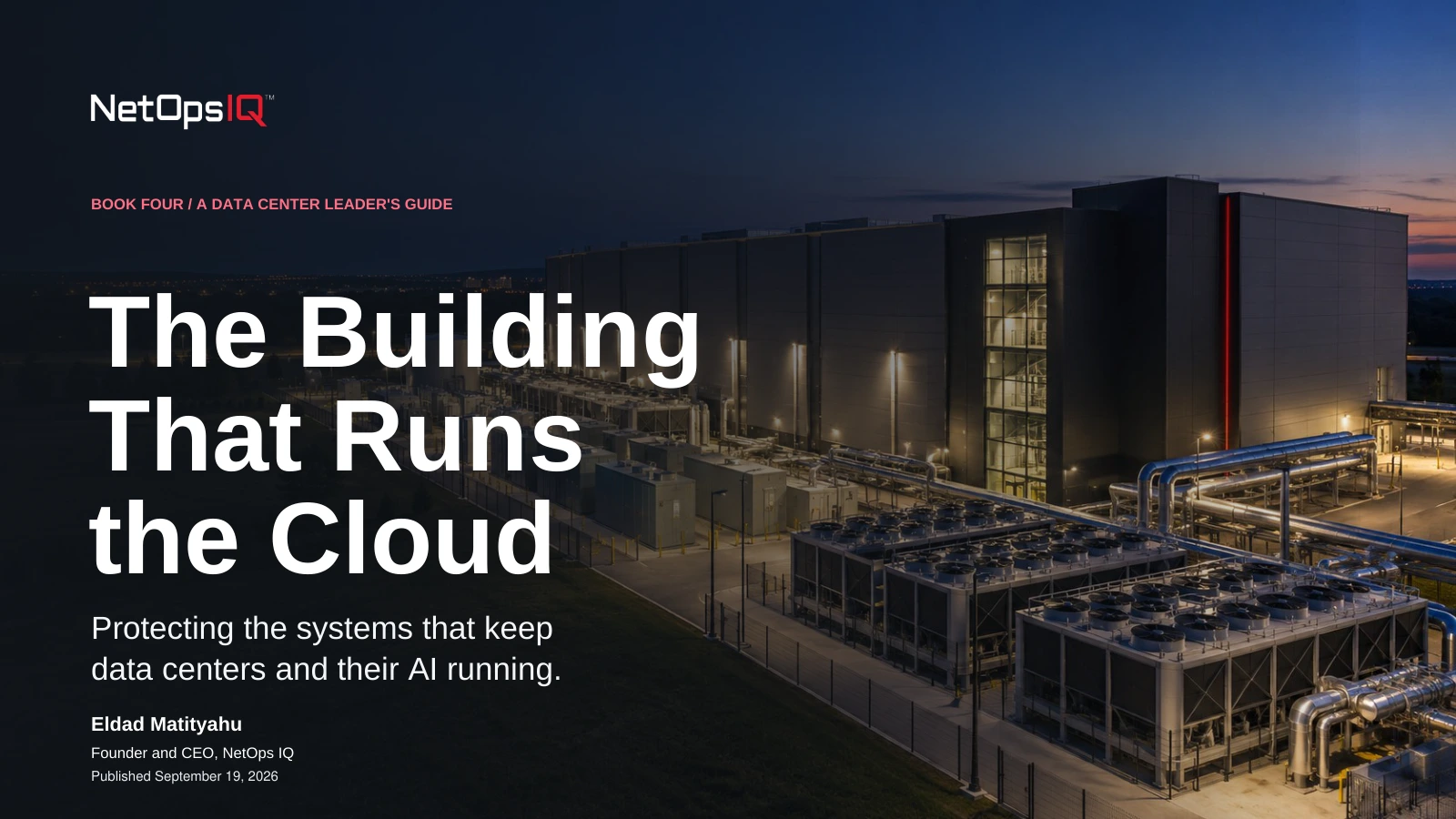
The cloud lives in a building.
Chillers, batteries, generators, sensors and locked doors keep the servers alive. When the building fails, the digital service fails with it.

BOOK FOUR / AN AI DATA CENTER LEADER’S GUIDE
Can we contain the risk without causing the outage?
Cooling. Power. Alarms. Access. The building systems that keep the cloud running.
The complete book. No form or registration.
THE FOUR IDEAS
Every story in this book is a branch off four ideas.
Chillers, batteries, generators, sensors and locked doors keep the servers alive. When the building fails, the digital service fails with it.
Most have software, a login and a network connection. Facilities or a vendor runs them, so security often can’t see them.
Cut off the wrong device and the server hall heats up. So every response has to be narrow, and decided before the night it’s needed.
The bad path is closed. The building is still doing its job. One without the other leaves the case open.
READ AT YOUR OWN PACE
A letter from Eldad · How to read the stories
The servers are easy to see. The systems that keep them alive often are not.
CHAPTER 02A cooling problem can become a global business outage.
CHAPTER 03The attack took one region. Uncertainty took the controls for every region.
CHAPTER 04The easiest way in may be through the room around the server.
CHAPTER 05An attacker doesn’t need your server rack if they can reach what keeps it running.
CHAPTER 06In a high-uptime building, looking too hard can be its own risk.
CHAPTER 07Not every device problem deserves the same response.
CHAPTER 08A secure controller that no longer runs the cooling is a failure.
CHAPTER 09Uptime depends on what you can see as much as what’s running.
CHAPTER 10Skip the security budget pitch. Ask what one hour of uncertainty costs.
KNOW WHAT YOU ARE READING
NetOps IQ work in logistics, water and power generation. These are not data-center pilots.
Outside reporting and research, with linked source notes and publication dates where available.
Scenarios built to explain the method. The data-center response story and photographic artwork are illustrative.
Support for liquid-cooling pumps, leak sensors and controllers must be confirmed for your equipment and approved actions. The GPU hardware and fast compute network are outside this book’s Findavi scope.
START WITH ONE CRITICAL SYSTEM
A scoped, on-site, listen-only assessment of connected devices, exposed paths, accountable owners and supported response options.
One server hall, one cooling zone, or one vendor access path. A typical assessment takes a few days, depending on the size of the site.
Request an assessmentThe assessment only listens. Any later action needs separate approval. Control and safety decisions stay with your facilities team.